Social media kit
Everything you need to share fwi-chain: images, ready-to-post texts, and
hashtags. Copy, adapt, and post. Thank you!
Link: https://github.com/agent-engineering-studio/fwi-chain
Install: pip install fwi-chain
Images
| Image | Use it for | File |
|---|---|---|
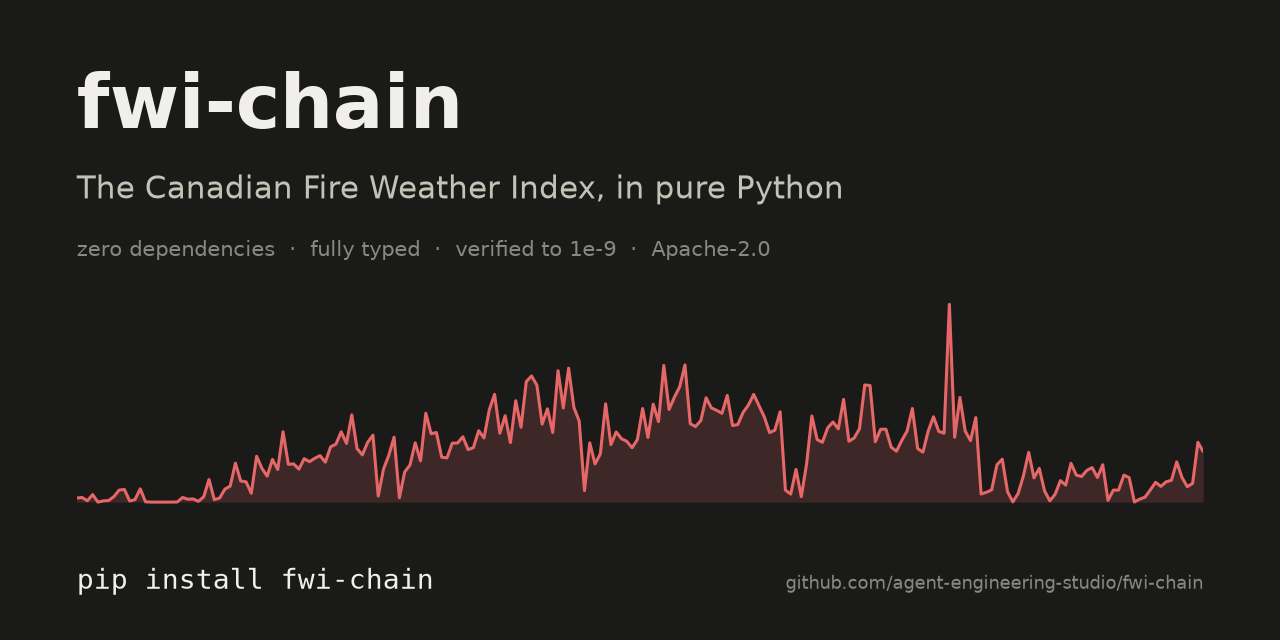
| Social card, 1280 × 640 | GitHub social preview, link previews, X / LinkedIn / Mastodon | images/social-preview.png |
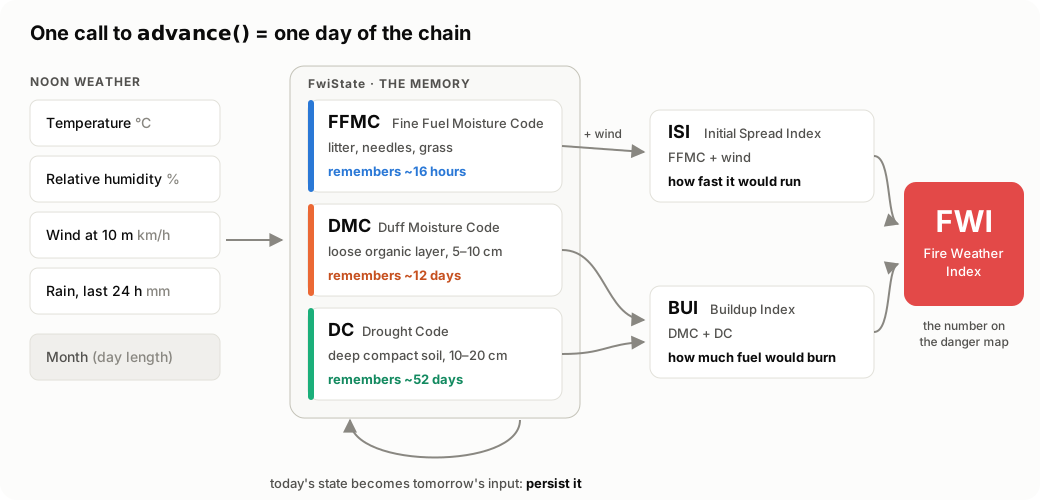
| The chain diagram | explaining what the FWI is | images/fwi-chain-diagram.svg |
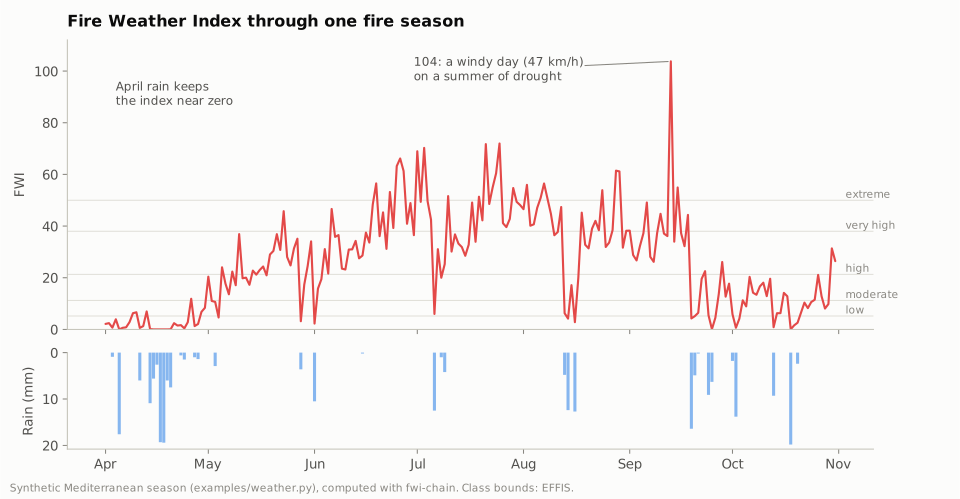
| A fire season | the "wow" chart | images/fire-season.svg |
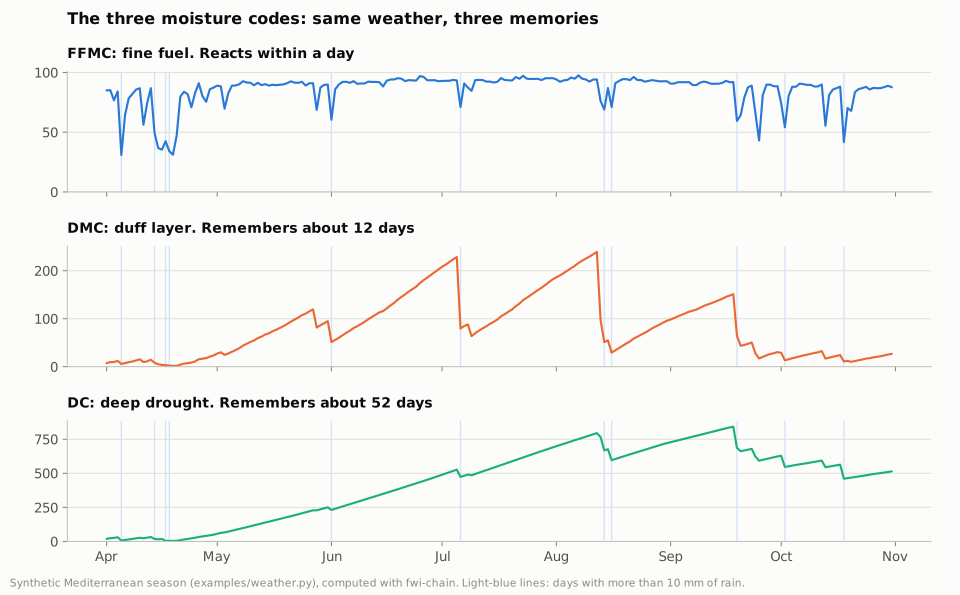
| Three memories | the science hook | images/moisture-codes.svg |
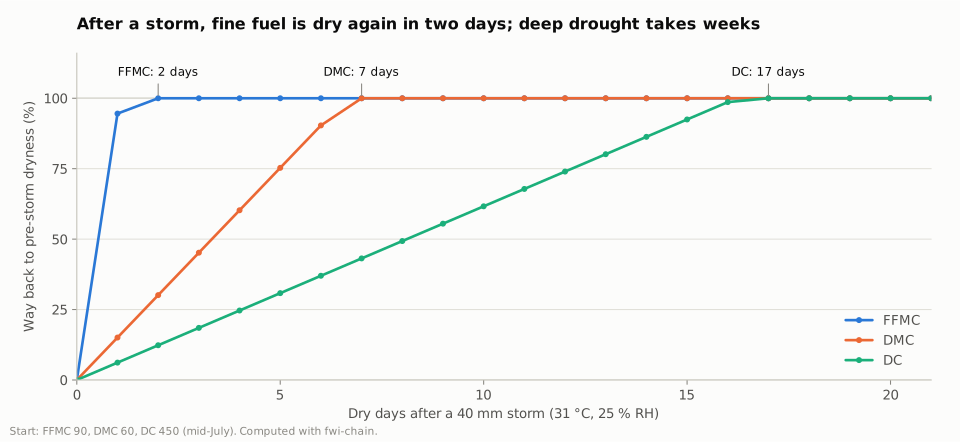
| Storm recovery | the "did you know" hook | images/memory.svg |
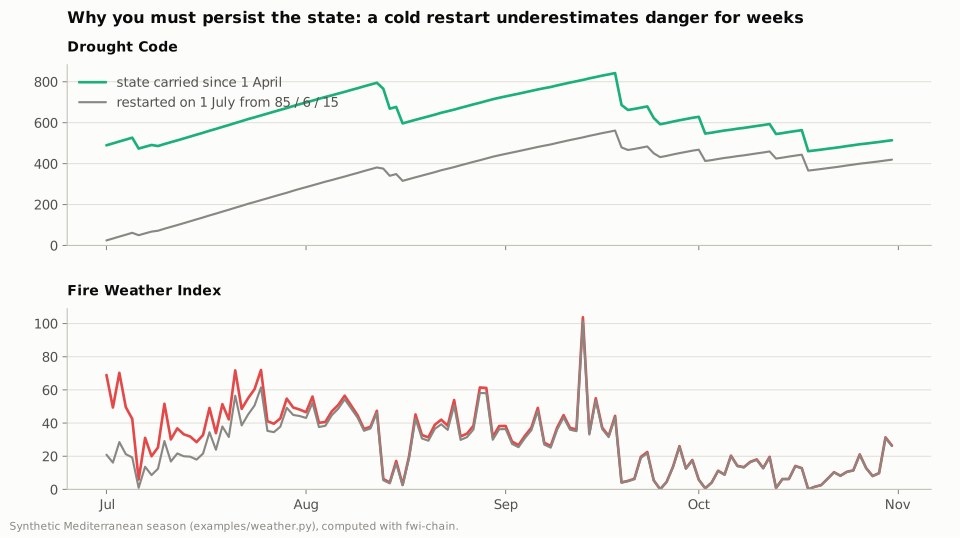
| Cold restart | the engineering hook | images/restart.svg |
Most platforms do not accept SVG uploads. Export a PNG by opening the SVG in a browser and taking a screenshot, or run
uv run --with cairosvg python -c "import cairosvg; cairosvg.svg2png(url='docs/images/fire-season.svg', write_to='fire-season.png', output_width=2000)".
Set the GitHub social preview once: repository → Settings → General →
Social preview → upload docs/images/social-preview.png.
LinkedIn
🔥 Wildfire danger, in about 300 lines of pure Python.
We just open-sourced fwi-chain: the Canadian Forest Fire Weather Index (FWI), the index fire services and the European EFFIS publish every day, as small, typed, dependency-free Python functions.
Four noon readings (temperature, humidity, wind, rain) → six numbers that say how easily a fire would start, how fast it would spread, and how hard it would be to fight.
What makes it different: ✅ Zero dependencies: it fits in a database job, a stream processor, a serverless function ✅ Verified, not just tested: all six outputs match the published reference day to 1e-9 ✅ The "memory" of the forest floor (weeks of drought) is an explicit state you persist, not hidden in an array ✅ Every line tied to an equation number in Van Wagner (1987)
It already runs the wildfire danger chain for every ~9 km weather node in Italy.
We're looking for contributors: fire scientists, meteorologists, Python developers, technical writers. There are good first issues for everyone.
👉 https://github.com/agent-engineering-studio/fwi-chain
wildfire #opensource #python #climate #firescience #meteorology #EFFIS
(attach social-preview.png or fire-season.png)
X / Bluesky / Mastodon
Launch (≤ 280 chars)
🔥 fwi-chain: the Canadian Fire Weather Index in pure Python. Zero deps · fully typed · verified to 1e-9 against the reference day · Apache-2.0
pip install fwi-chain https://github.com/agent-engineering-studio/fwi-chain
Python #wildfire #opensource
Science hook (attach memory.svg as PNG)
After a 40 mm storm in July: 🌾 fine fuels are bone-dry again in 2 days 🍂 the duff layer takes a week 🪵 deep drought takes 17+ days
That memory is why fire danger is a chain, not a formula. Explained, with code: https://github.com/agent-engineering-studio/fwi-chain/blob/main/docs/how-fwi-works.md
Engineering hook (attach restart.svg as PNG)
Bug you won't see in a unit test: restart your fire-danger model mid-season from default values and it underestimates danger for weeks.
fwi-chain makes the state explicit, so you can't forget to persist it. 🧵👇 https://github.com/agent-engineering-studio/fwi-chain
Thread (5 posts)
- 🔥 How do fire services decide that today is "extreme" fire danger? Most use the Canadian Fire Weather Index. We open-sourced a tiny, verified Python implementation. A thread on how it works 🧵
- It needs only 4 noon readings: temperature, humidity, wind, and 24 h rain. From them it computes 3 moisture codes, one for each layer of the forest floor, from surface litter to deep soil. (diagram)
- Each layer has a different memory: ~16 hours, ~12 days, ~52 days. So today's danger depends on the whole season, and that's why it's a chain. (moisture-codes)
- Forget that memory (restart mid-season) and you underestimate danger for weeks. fwi-chain hands you the state as a plain value: store it in SQL, a file, a cache. (restart)
- Zero deps, mypy --strict, verified to 1e-9, Apache-2.0. Contributors welcome: reference data, latitude tables, docs, translations. ⭐ https://github.com/agent-engineering-studio/fwi-chain
Reddit (r/Python, r/datascience, r/gis, r/meteorology)
Title: I open-sourced a zero-dependency, verified implementation of the Canadian Fire Weather Index
Body:
The FWI is the fire danger index used across Canada, by EFFIS for Europe, and by many other agencies. I extracted the implementation we use in production (Italy, ~9 km grid) into a standalone package:
- pure functions, no NumPy, no I/O, about 300 lines,
mypy --strict- verified against the cffdrs reference day to 1e-9, plus tests for every rain branch and for physical bounds
- the recursive state (the "memory" of the forest floor) is an explicit dataclass you persist yourself
For gridded climate data xclim is still the better tool. This one is for services, databases and streams.
Docs explain the science in plain words, with charts generated by the library. Feedback and contributions very welcome!
https://github.com/agent-engineering-studio/fwi-chain
Hacker News
Title: Show HN: fwi-chain – the Canadian Fire Weather Index in pure, verified Python
Hashtags
#wildfire #firescience #FWI #Python #opensource #climate #meteorology
#EFFIS #GIS #climatechange #forestfire #datascience
Suggested GitHub topics
Add them under About → ⚙️ on the repository page:
fire-weather-index  wildfire  fwi  python  meteorology  climate  fire-danger
forest-fire  cffdrs  van-wagner  zero-dependency  typed
Key facts (for writing your own post)
- Implements Van Wagner (1987), Forestry Technical Report 35.
- 6 outputs: FFMC, DMC, DC, ISI, BUI, FWI.
- Python 3.12+, no runtime dependencies, Apache-2.0.
- About 300 lines of library code. Reference day matched to an absolute 1e-9.
- A few microseconds per location per day.
- Extracted from Limen, which runs it on every ~9 km node in Italy.